
Toe shoes for bunions: what actually helps
Peluva Team
September 17, 2026 · 6 min read
You’ve tried the wide shoes, the gel pads, the night splints. The bunion still hurts by lunchtime.
Here’s what’s really going on at that joint, what most “bunion shoes” still get wrong, and why barefoot shoes with toe separators are the exception.
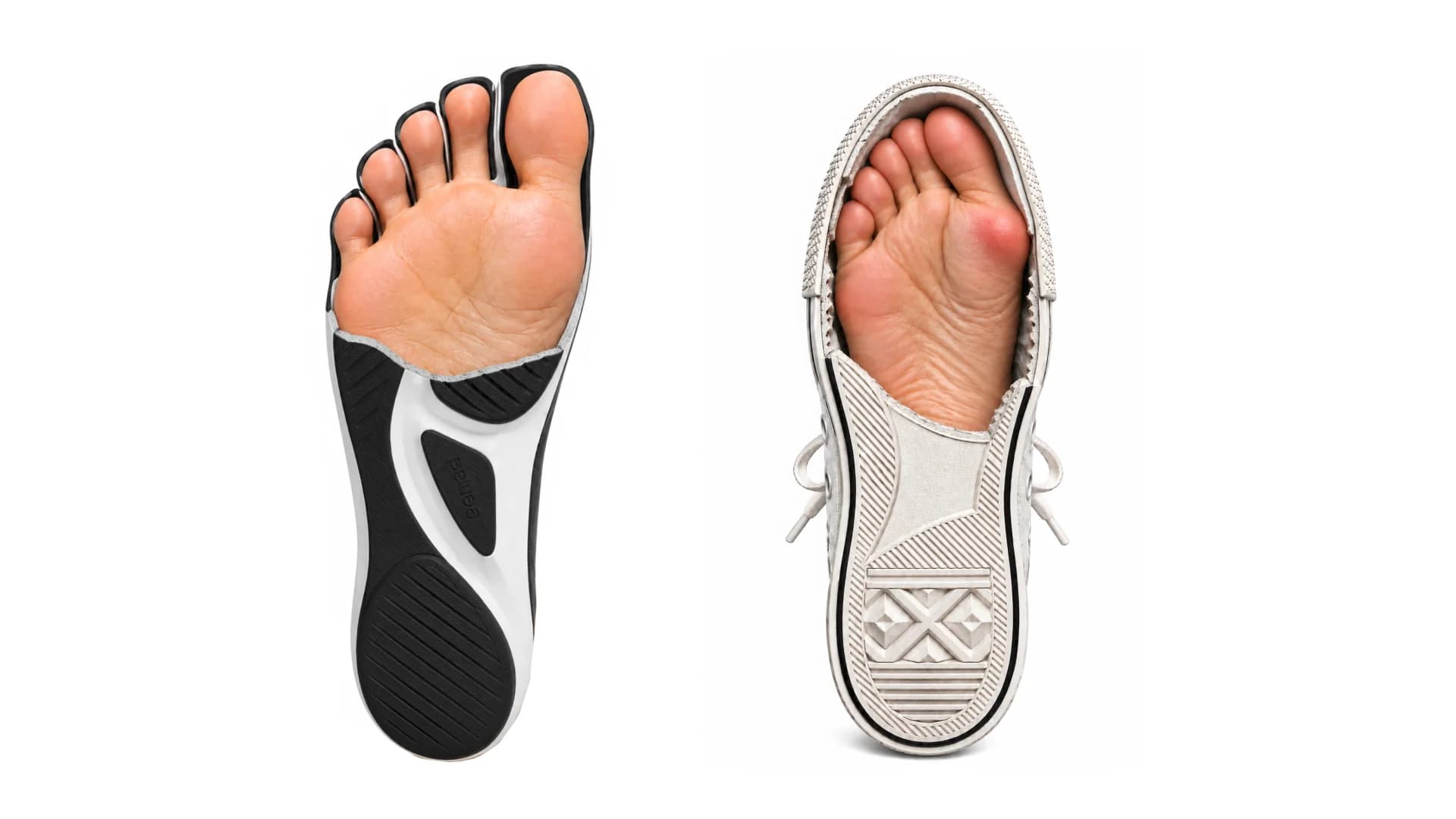
Peluva was built on the science of the foot: 26 bones, 33 joints and over 100 muscles that only work when every toe can move on its own. Several years of R&D went into a five-toe shoe with enough cushion for real life. Podiatrists now recommend it to their patients.

“Peluvas five-toe design and flat, flexible sole enables natural posture, groundfeel, and toe splay. Peluvas provide the ideal environment for the nerves, joints, bones, muscles and tendons to rehabilitate and strengthen.”
What a bunion actually is
A bunion (hallux valgus, if your podiatrist is talking) is a big toe that has been pushed toward its neighbors for so long the joint gave way. The base of the toe angles out. That’s the bump.
Some feet are born more prone to it. But people who live barefoot rarely get bunions, and people in conventional shoes get them at roughly one in four. The difference is the shoe.
It isn’t an old-feet problem, and it isn’t automatically a surgery question. The drift starts years before the bump shows, and for mild to moderate bunions a shoe that stops the squeeze is a real part of managing it.
Why shoes do this
Your foot is widest at the toes. Most shoes are widest at the ball and taper from there, so every step nudges the big toe inward.
Years of that, and the muscle pulling the toe in gets short and tight while the one pulling it back gets stretched and weak. The imbalance turns structural. The joint changes shape.
A raised heel makes it worse. It tips your weight onto the ball of the foot, straight onto the joint that’s already struggling.
What doesn’t work on its own
A wide toe box. It’s a real improvement, and brands like Altra and Vivobarefoot deserve credit for it. But inside one shared box, toes still bunch and overlap, and nothing keeps the big toe in its lane. Mittens keep your hands warm. Only gloves let your fingers work.
A toe spacer. It works while it’s on. Take it off, put the shoe on, and the squeeze is back.
The solution
A gentle, all-day toe spacer built into your shoe
Each toe gets its own slot. Your big toe sits where it belongs on every step, all day, so the squeeze that causes and worsens a bunion stops for as long as the shoes are on.
With the toe held in place, the muscle that pulls it back into line can finally do its job, and the small muscles between the toes wake up. Stop compressing the toe. Start strengthening what holds it.
Zero-drop means your weight spreads across the whole foot instead of landing on the sore joint. 9mm of cushion means you can wear them all day on pavement, not twenty minutes on a mat. The upper is soft and flexible, so nothing stiff presses on the bump.
Many customers with bunions tell us they feel relief within the first few weeks. Results vary. The mechanism doesn’t.
Start here
“I bought these shoes out of desperation. My feet hurt badly after years of nursing.”
Men'sStrand Sport Mesh
10% off using FOOTHEALTH10


In their words
128 customers with bunions say it better than we can.
If you have a bunion and LONG second toe, read this!
I am amazed! This is the only shoe that I can wear all day long not not have my bunion feel like it is going to explode - check out the ugly picture! The history about my cramped toes and bunion: I ran track through college and jammed my feet into very tight track spikes, then spent 38 years in small toe box dress shoes (I was a CEO), and now play tennis using shoes that don't help the situation.
On top of that, I have the long second toes that make every shoe fit problematic.
Read Len’s full review ↓Show less ↑
On longer! I have had the strand atr for 4 days and have had zero issues. I'm a size 9 and ordered a 9.5 along with the socks (I'm now using toe socks with my tennis shoes). The long toe has a little space and at first I thought it was rubbing against the edge while walking, but that is starting to go away as I wear the shoe. The other toes have a good gap, so ordering a 10 might be too much. Most of what I am feeling is the toe actually doing its job on the surface of the ground, which is something you might have to get used to.
For kicks, I did a few sprinting bursts and felt like I could run 10.1 in the 100 again! I wear them around the house, for walks, and working out.
What are the downsides?
1) Getting used to how to put them on. By day 2, I figured out that if I WIGGLED MY TOES while sliding my foot on, the toes find the slots much easier.
2) Deciding whether to go a half size larger or one size larger regarding the toe fit. There is some contradictory info on the website about fit - one section recommends half a size larger, and the shoe-specific section indicates one size larger. This causes a lot of second-guessing what to order, i.e., at first I wanted to return for size 10, but gave it time and decided to keep the 9.5.
Overall, I wear these things all the time now (except on the tennis court - but if Mark wants to send me a free tennis version, I'll play test them!). My wife thinks they look wierd but is putting up with them in public!
They call me the "Flash" and now, because of the way the shoe looks, I am officially the Tiger Flash!


Thirty days to find out for yourself, free exchanges if the size is off. 10% off using FOOTHEALTH10.
Try the Strand Sport Mesh →How to start with a bunion
Walk first. Everyday wear and walking are where the foot rebuilds. Save workouts for when your feet have a foundation.
Go barefoot at home. Peluvas outside, bare feet or five-toe socks inside. Fewer hours in a tapered shoe is the point.
Go up a half size. Most returns are from pairs that felt tight. With a bunion or a longer second toe, the extra room keeps every toe comfortable.
Expect a toe battle the first few times. Toes that have spent years wedged together take a moment to find their slots. Guide the big toe and second toe in first. It gets easier, and that’s the shoe doing its job.
For the foot and toe exercises, read our post on bunions.
A note on medical advice
For mild to moderate bunions, footwear with toe separation can be a meaningful part of managing it. For a severe bunion that limits how you move, see a podiatrist or orthopedic specialist.
Walk first. That starts with a pair. 10% off using FOOTHEALTH10.
Start with the Strand Sport Mesh →Barefoot shoes for bunions: your questions, answered
Are barefoot shoes good for bunions?
Shoes that taper at the toe push the big toe inward, which is the pressure that aggravates a bunion. Peluva's five individual toe slots remove that pressure and let each toe sit where it naturally wants to. Customers with bunions most often tell us the first thing they notice is that the all-day squeeze is gone.
Can Peluva fix or reverse a bunion?
We don't claim that. A bunion is a change at the joint, and how far it goes back depends on how far it has progressed and on your feet. What Peluva does is stop pushing the toe the wrong way for every hour you wear them, and many customers with mild to moderate bunions say their toe feels and looks straighter over time. For a severe bunion, talk to a podiatrist.
Which Peluva is best for bunions?
Start with a Strand. The knit upper is soft over the joint, so nothing presses on the bump, and it is the shoe most of our bunion reviews are written about. The Zen slip-on is a good second pair for around the house: no laces, no pressure points.
Will the toe slots rub my bunion?
The slot sits between the toes, not over the joint, and the upper is a soft knit rather than a stiff leather. Most people feel the slots as unfamiliar for a few days, then stop noticing them. If the big-toe slot feels tight at first, wear them for short sessions and let the knit relax.
What size should I get if I have a bunion?
Size for your longest toe, which is often the second toe once the big toe angles in. Many customers with bunions go up a half size from their usual sneaker. Exchanges are easy if the first pair isn't right.
Are Vivobarefoot or other wide toe box shoes good for bunions?
Better than a tapered shoe, and brands like Vivobarefoot and Altra deserve credit for the wider box. But inside one shared toe box the big toe can still drift toward its neighbor with nothing holding it in place. Wide toe boxes stop the harm; individual toe slots keep every toe in its own space all day.
Are five finger shoes good for bunions?
The original five-finger shoes proved the idea: separating the toes changes how you stand and move. The catch is the sole, around 3mm of cushion, which makes them a fitness-only shoe for well-adapted feet. Peluva keeps the five individual toe slots and adds around 9mm of cushion, so you can wear them all day on pavement, which is where a bunion needs the pressure off most.
Are zero drop shoes good for bunions?
A raised heel tips your weight forward onto the ball of the foot, straight onto the big-toe joint, so a flat, zero-drop sole takes load off a bunion. On its own it doesn't stop the squeeze, though. Zero-drop plus a tapered toe box is still a tapered toe box. Look for zero-drop and toe separation together.
10% off using FOOTHEALTH10.
Give your big toe its room back →Read more about bunions and your feet
- Should you wear Peluvas if you have bunions?Brad Kearns on why bunions happen, and the three-step routine: the shoes, the exercises, barefoot at home.Read →
- Why five toe slots, not just a wide toe boxThe science page: how modern shoes deform feet, and the before-and-after X-rays.Read →
- Can five-toe socks fix your feet?Mark Sisson on what toe socks do for toe spread, and what they can't do on their own.Read →
- Popular shoe features that are bad for your feetTapered toe boxes, raised heels, stiff soles: the design choices that push a big toe out of line.Read →
- Sizing, the first try-on, and returnsHow to size up, how to get each toe into its slot, and how exchanges work.Read →